
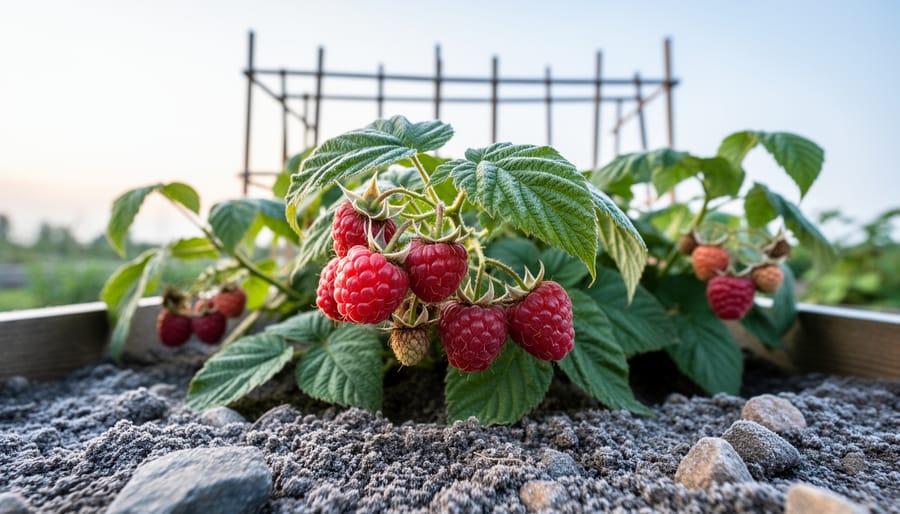
Why Colorado Gardeners Succeed with Raspberries (And What Alberta Growers Can Learn)
Growing raspberries in Colorado mirrors many of the challenges we face here in Alberta’s Zone 3 gardens, and honestly, that’s exactly why Colorado growers keep finding their way to our community. When you’re dealing with intense sun, dramatic temperature swings, unpredictable late frosts, and bone-dry air, the traditional raspberry-growing advice from milder climates falls apart fast.
I learned this the hard way back in 2019 when a friend from Fort Collins visited my Alberta garden and we spent an entire afternoon comparing notes on our shared struggles. Her raspberries were battling scorching afternoons at 7,000 feet while mine were nursing frost damage in May. Different geography, same fundamental problem: we were both trying to grow a crop that prefers gentle maritime climates in places that laugh at the word “gentle.”
The good news? Raspberries are tougher than most gardeners think. I’ve watched canes bounce back from minus 35 winters and produce abundant crops by July. The secret isn’t about fighting your climate but working with it, choosing varieties bred for temperature extremes, timing your plantings to dodge late freezes, and understanding that what works in Oregon or Washington needs serious adaptation for high-altitude, low-humidity conditions.
Whether you’re gardening in Colorado Springs, Denver, or the western slope, or joining us from central Alberta, the principles remain surprisingly consistent. We’re all dealing with short growing seasons, intense UV exposure, and the constant need to balance adequate chilling hours against protecting tender spring growth.
This guide pulls from years of cold-climate raspberry growing, community wisdom from hundreds of Zone 3 gardeners, and specific techniques that actually work when your summer nights drop into the forties and your soil dries out between rainstorms. Let’s grow some berries.
The Colorado-Alberta Climate Connection
When I first started comparing notes with raspberry growers from Colorado’s Front Range, I was struck by how eerily familiar their challenges sounded. The conversations felt like talking to neighbours just down the road in Alberta, despite the hundreds of miles between us.
Colorado’s climate zones, particularly the Front Range stretching from Fort Collins to Colorado Springs and the mountain valleys between 5,000 and 8,000 feet elevation, face remarkably similar conditions to Alberta’s Zone 3 regions. Both areas contend with the same fundamental obstacles: brutal winter cold that can plunge below -30°F, wild temperature swings that can shift 40 degrees in a single day, and growing seasons that feel frustratingly short when you’re trying to coax fruit from your canes.
| Climate Factor | Colorado Zones 3-5 | Alberta Zone 3 |
|---|---|---|
| Average Last Frost | May 10-25 | May 15-30 |
| Average First Frost | Sept 15-30 | Sept 10-20 |
| Growing Days | 110-140 | 100-125 |
| Winter Lows | -25°F to -35°F | -30°F to -40°F |
| Summer Highs | 85°F to 95°F | 75°F to 85°F |
The parallels extend beyond the numbers. Both regions wrestle with intense UV radiation at higher elevations and latitudes, which can stress plants even as it promotes sugar development in berries. Low humidity defines both climates, creating desiccation challenges during winter and making consistent irrigation critical during the growing season. Colorado gardeners in Boulder or Longmont deal with the same chinook winds that we experience in Calgary, those warm, dry blasts that can desiccate canes in hours if they’re not protected.
This climate kinship means techniques proven in Colorado backyards translate directly to Alberta gardens. When a grower in Estes Park solves a winter protection problem, they’ve essentially solved it for someone in Red Deer too.
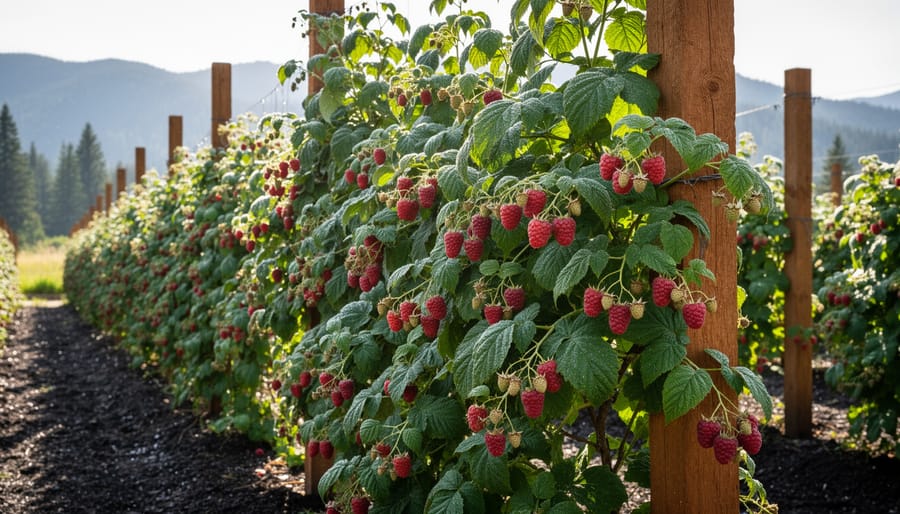
Raspberry Varieties That Thrive in Both Regions
Summer-Bearing Champions
Colorado raspberry growers consistently reach for three summer-bearing varieties that laugh at late spring frosts and produce heavily despite short seasons: Boyne, Nova, and Killarney. I first heard about this trio from a Fort Collins gardener who’d been growing them successfully at 5,280 feet for over a decade, and her enthusiasm was contagious.
Boyne stands out as the earliest producer, ripening fruit in late June to early July, a crucial advantage when your growing window slams shut in September. This Canadian-bred cultivar handles temperatures down to -40°F without blinking, and Colorado growers report excellent yields even after brutal winters. The berries are medium-sized with intense flavour, perfect for fresh eating or preserves. One Denver gardener told me she gets her first harvest a full two weeks before her neighbours growing other varieties.
Nova delivers slightly larger berries with exceptional firmness, making it ideal if you’re growing for market or need fruit that travels well to community garden share tables. It ripens mid-season and produces reliably heavy crops. Colorado growers particularly appreciate its strong canes that don’t require quite as much support as other varieties.
Killarney rounds out the trio with late-season production, extending your harvest into August. Its berries are notably sweet with lower acidity, and the plants show impressive resistance to root rot, a real concern in Colorado’s clay soils and equally relevant for Alberta gardeners dealing with heavy spring moisture.
Fall-Bearing Favorites
Colorado gardeners swear by fall-bearing raspberries for one simple reason: they produce fruit on first-year canes, which means you get berries even if winter kills everything back to the ground. I learned this the hard way after watching my summer-bearing plants sulk through a late spring freeze in Alberta, while my neighbour’s fall-bearing canes just kept pushing forward.
Autumn Britten has become the gold standard in Colorado’s mountain communities. This British variety produces large, firm berries starting in late August and keeps going until hard frost. Colorado growers love that it handles temperature swings without dropping flowers, and the berries hold up beautifully for fresh eating or freezing. The canes grow upright and sturdy, reaching about five feet, which makes them manageable even in windy spots.
Polana deserves special attention for short-season gardens. Originally bred in Poland for cold climates, this variety starts fruiting earlier than most fall types, often by mid-August in Colorado. The berries are medium-sized but intensely flavoured, and the plants produce heavily even in their first year. Several Denver-area gardeners told me they get twice the yield from Polana compared to Heritage in the same space.
Fall-bearing varieties offer distinct advantages when you’re racing against frost:
- Fruit production on new growth means you can mow everything down in late fall for simplified winter care
- No worrying about protecting overwintered canes from freeze damage
- Fresh berries arrive when summer varieties have finished, extending your harvest window into October
- Simpler pruning, just cut everything to ground level before snowfall
Heritage remains the reliable workhorse that Colorado gardeners recommend to beginners. While it starts fruiting slightly later than Polana, the flavour is exceptional and the plants tolerate poor soil better than fussier varieties. The berries freeze beautifully, which matters when you’re harvesting in September and October. Alberta gardeners will find Heritage performs similarly here, though our first frost often comes two weeks earlier than Colorado’s Front Range.
Site Selection Lessons from Colorado’s High Country
# Site Selection Lessons from Colorado’s High Country
Last summer, I spoke with Maria, a raspberry grower outside Boulder who’s been coaxing bumper crops from her 7,200-foot garden for over a decade. Her first piece of advice? “Location makes or breaks your raspberry patch up here. Get it wrong, and you’ll fight losing battles every season.”
Colorado’s high-country gardeners have learned through trial and error that raspberries need full sun, but not just any sunny spot will do. They aim for southern or southeastern exposure that captures morning light while offering some afternoon respite during the intense mountain sun. In Alberta, we deal with less UV intensity but shorter days, making that eastern exposure equally valuable for maximizing growing hours in our brief season.
Wind protection ranks as the second non-negotiable for Colorado growers. At elevation, desiccating winds can damage canes and dry out soil faster than you can water. Successful growers position their patches near existing windbreaks like fences, sheds, or evergreen hedges on the north and west sides. The trick is placing raspberries close enough to benefit from protection without competing for nutrients or getting shaded. Maria keeps her canes twelve feet from her spruce windbreak, which blocks the worst gusts without casting shadows.
The concept of microclimates becomes crucial in mountainous terrain, and Colorado gardeners exploit every advantage. They plant against south-facing walls that radiate stored heat into cool evenings, extending the growing window by precious days. Some create deliberate heat sinks by positioning dark rocks or water barrels near their patches. One grower in Estes Park swears by planting her fall-bearing varieties on a gentle south-facing slope where cold air drains away naturally, preventing those devastating late-spring frosts that can wipe out blossoms.
Drainage matters enormously. Colorado’s clay soils and sudden downpours mean low-lying areas become waterlogged death traps for raspberry roots. The most successful patches sit on slight rises or berms where water moves away naturally. For Alberta gardeners dealing with spring melt and clay hardpan, this lesson translates directly: never plant raspberries in the lowest spot of your yard, no matter how convenient it seems.
Soil Preparation: The Colorado Way
Colorado’s Front Range soils could be Alberta’s twin, both regions battle heavy clay, high pH, and stubborn drainage issues that make raspberries sulk. I learned this firsthand when a Denver gardener shared her soil test results at a seed exchange: pH 7.8, compacted clay, almost identical to what I dig up in my Zone 3 yard. What struck me was how she’d transformed that brick-like earth into a thriving raspberry patch within two seasons.
The secret? Colorado growers don’t fight their soil, they rebuild it entirely in the planting zone.
Most successful Colorado raspberry gardeners start by testing their soil pH in early spring, aiming for that sweet spot between 5.5 and 6.5. Garden centers along the Front Range stock sulfur products year-round because the demand never stops. Elemental sulfur works slowly but reliably, lowering pH over several months without shocking plants. Colorado growers typically apply it in fall, giving it winter to work its magic before spring planting.
Here’s the amendment process that’s become standard practice in Colorado’s high-altitude raspberry patches:
- Remove soil from the planting area to a depth of 18 inches and set aside (this becomes part of your amended mix later)
- Loosen the bottom 6 inches with a garden fork to break up any hardpan layer that blocks drainage
- Mix the removed soil with equal parts peat moss or coconut coir to acidify and lighten texture
- Add one part coarse sand or perlite to every four parts of the soil-peat mixture for drainage
- Blend in 3 to 4 inches of well-aged compost for nutrients and beneficial microbes
- Work in elemental sulfur at the rate recommended by your soil test (typically 1 to 2 pounds per 100 square feet)
- Refill the planting area with this amended mix, mounding it slightly to encourage runoff
The raised bed approach dominates Colorado raspberry growing for good reason. Even a modest 6-inch elevation above grade prevents spring meltwater from pooling around crown tissue, where rot loves to start. One Fort Collins grower told me she hasn’t lost a single plant to root rot since switching to raised rows, despite Colorado’s unpredictable spring freeze-thaw cycles.
Alberta gardeners can skip the guesswork by adopting this same approach. Our clay doesn’t drain any better than Colorado’s, and our pH often runs just as high. The investment in amendments pays back within the first harvest.
Planting Techniques That Beat the Cold
Colorado raspberry growers have learned through trial and error that the first two weeks after planting determine whether your canes will thrive or merely survive. The most successful technique they’ve adopted is planting in raised beds 8 to 12 inches high. This simple change warms the soil 3 to 5 degrees earlier in spring and improves drainage during those sudden snowmelts that can waterlog roots overnight.
Timing matters more than you might think. Colorado gardeners who plant in late April or very early May, when soil temperatures reach 45°F consistently, see their raspberries establish 40% faster than those who rush it in March. The soil needs to be workable but not warm, you want the roots growing before the canes leaf out and start demanding water.
Spacing is where many new growers stumble. Colorado’s best producers plant their canes 2 to 2.5 feet apart in rows spaced 6 feet wide. This sounds generous until you realize it allows air circulation that prevents the fungal issues our humid summer thunderstorms can trigger. Crowded canes create their own problems in cold climates because they trap moisture against the crown, inviting winter rot.
One technique worth copying is planting at the same depth the cane grew in the nursery, you’ll see the soil line on the stem. Going deeper doesn’t protect the plant; it just smothers the crown. Colorado growers firm the soil gently around roots, water thoroughly, then add 2 inches of shredded bark mulch pulled back 3 inches from the cane itself.
The smartest Colorado gardeners plant on a cloudy day or in late afternoon. Transplant shock hits harder at elevation and in our intense sun. Give those roots a few hours to settle before they face full sunlight, and you’ll see the difference in how quickly new growth appears.
Winter Protection Strategies
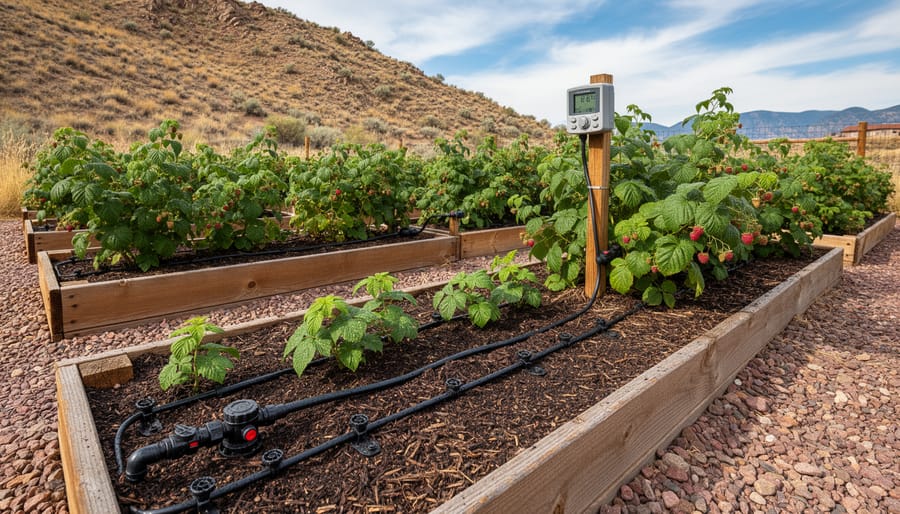
Colorado gardeners have learned through trial and error that the biggest threat to raspberries is not the absolute low temperature, but the brutal freeze-thaw cycles that hit the Front Range and mountain valleys from November through March. One grower I spoke with in Fort Collins lost an entire patch in her second year before discovering that proper winter protection starts in late summer with cane selection.
The key difference between Colorado and Alberta winter management is snow reliability. While Alberta gardeners can often count on persistent snow cover as natural insulation, Colorado’s unpredictable snowfall means deliberate protection matters more. Successful Colorado growers cut back fall-bearing varieties to ground level after the first hard freeze, which eliminates the need for cane protection entirely and is why fall types dominate the region. For summer-bearing varieties, they select only the strongest six to eight canes per linear foot in late September, removing the rest to concentrate the plant’s winter resources.
Mulching becomes critical once temperatures regularly dip below freezing. Colorado trials have shown that not all materials perform equally in protecting root zones and crown tissue:
- Wood chips (4-6 inches deep): Best overall performer, insulating to -15°F with good moisture retention
- Straw bales placed around canes: Excellent wind protection but requires removal before spring warmth triggers mold
- Shredded leaves (6-8 inches): Effective and free, though they compact and may need midwinter fluffing
- Pine needles: Adequate in milder areas but insufficient for exposed, windswept sites
A Denver-area grower taught me to apply mulch for winter protection in two stages: a light three-inch layer in October, then another three inches after the ground freezes hard. This prevents rodent nesting while maximizing insulation.
The most clever Colorado technique involves creating artificial snow fences using burlap or hardware cloth on the windward side of raspberry rows. These structures trap blowing snow exactly where you want it, building a protective drift over the canes. When snow does fall in the high country, experienced growers leave it undisturbed rather than clearing paths through the patch. That packed snow acts as a temperature buffer that Alberta gardeners inherently understand but Colorado growers must engineer.
Irrigation and Water Management
Colorado’s semi-arid climate taught me something crucial about raspberries: they’re surprisingly thirsty plants that also hate wet feet. It’s a delicate balance I first witnessed at a Fort Collins community garden, where a grower lost half her canes to root rot despite watering religiously.
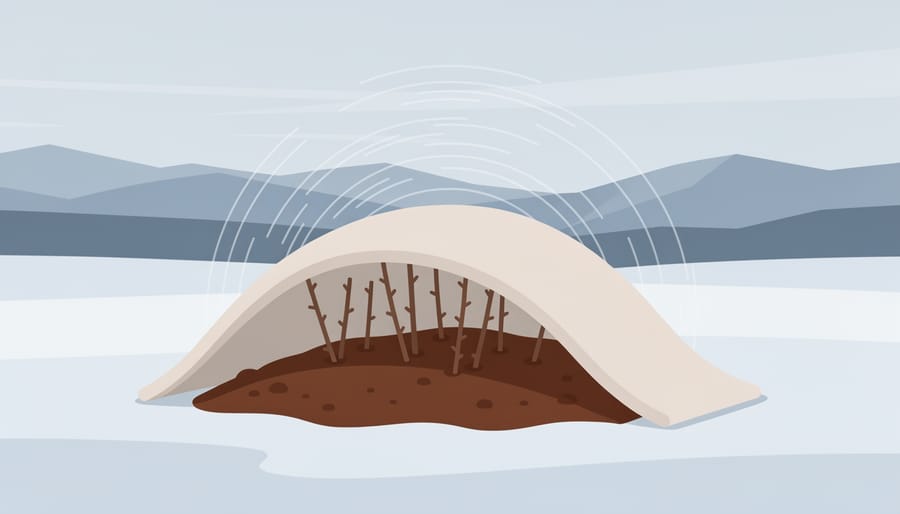
Most successful Colorado raspberry growers have abandoned overhead sprinklers entirely. Drip irrigation delivers water directly to the root zone without wetting the foliage, which prevents fungal diseases that thrive in our regions’ dry air but damp leaves. Position drip lines about 6 inches from the cane base, running the length of your row. During peak summer, Colorado gardeners typically run their systems for 45 minutes to an hour three times weekly, adjusting based on rainfall and soil texture.
The key is consistency. Raspberries need roughly 1 to 1.5 inches of water per week during the growing season, but erratic watering creates stress. Colorado’s intense sun and low humidity mean soil dries faster than you’d expect, particularly in raised beds. A simple moisture meter pushed 4 inches deep tells you when it’s time to irrigate again.
Mulching is non-negotiable for water conservation. A 3-inch layer of wood chips or straw around your canes reduces evaporation by up to 70 percent, a trick Colorado growers rely on when water restrictions hit during drought years. The mulch also moderates soil temperature swings that plague both Colorado and Alberta gardens.
Alberta gardeners face similar aridity, especially in southern regions. The same drip systems and mulching practices that keep Denver raspberries hydrated through 95-degree days work equally well protecting your plants through our chinook winds and dry prairie summers.
Common Mistakes (And How Colorado Growers Overcame Them)
I learned this the hard way when I connected with raspberry growers from the Denver area a few years back. One grower, Maria, shared photos of her first-year raspberry patch, beautiful green canes in June that turned into brown, crispy disappointments by August. Her mistake? Planting in full afternoon sun without any wind protection. In Colorado’s Front Range, just like here in Alberta, that western exposure brings scorching heat and relentless wind that can desiccate raspberry canes faster than you’d think possible. She rebuilt her patch with a simple fence on the west side and saw an immediate turnaround.
Another Colorado grower told me about his expensive lesson with fall-bearing varieties. He’d treated them like summer-bearing types, carefully preserving canes through winter only to get a pathetic harvest the following year. Fall-bearing raspberries produce on first-year canes, so keeping old wood actually reduces your yield and invites disease. Once he started mowing everything down to ground level each November, his harvests doubled. That single piece of advice transformed my own raspberry management.
The watering mistakes hit close to home. A Grand Junction grower confessed she’d been using overhead sprinklers, creating the perfect environment for fungal diseases in Colorado’s dry climate. Wet foliage plus intense sun equals powdery mildew and cane blight, every single time. She switched to drip irrigation running at ground level, and her disease problems vanished within one season. The investment paid for itself in saved plants and better fruit quality.
Perhaps the most common mistake Colorado growers mentioned was impatience with soil amendment. Several admitted they’d planted raspberries in their native alkaline clay after a single round of peat moss, expecting miracles. Raspberries need acidic soil with a pH around 5.5 to 6.5, and Colorado’s alkaline ground requires ongoing amendment, not a one-time fix. The successful growers told me they spent an entire season preparing their beds, adding sulfur and compost repeatedly, testing pH multiple times before planting a single cane.
One grower summed it up perfectly: “Raspberries will tell you what they need, but only if you’re willing to listen and adapt.” That mindset, treating failures as feedback rather than defeat, seems to separate thriving raspberry patches from abandoned ones, whether you’re gardening in Colorado or right here in Alberta.
I’ll be honest, when I first started researching Colorado raspberry growers, I didn’t expect to find so many solutions to problems we face right here in Alberta. But that’s the beauty of gardening across similar climates: the challenges might wear different postal codes, but the solutions often translate beautifully.
What strikes me most about Colorado’s raspberry success isn’t just the techniques themselves. It’s the mindset. These growers embraced their harsh conditions rather than fighting them. They selected varieties bred for cold. They worked with their soil instead of against it. They learned to see winter as an ally, not an enemy. That’s exactly the approach we need in Zone 3 Alberta.
As you plan your 2026 raspberry patch, I encourage you to try at least one Colorado-inspired technique, whether that’s planting Autumn Britten for a reliable fall crop, building a raised bed to improve drainage, or experimenting with strategic mulching for winter protection. Start small, observe carefully, and build on what works in your specific microclimate.
I’d love to hear how these methods perform in your Alberta garden. Have you already grown raspberries using similar techniques? Did you discover a variety that outperforms the rest in your area? Share your experiences with our Garden Seeds community. Your success story might be exactly what another gardener needs to finally achieve that abundant raspberry harvest they’ve been dreaming about.