

![]() |
|||||||||||||||
|
|||||||||||||||
Leaf Vegetables
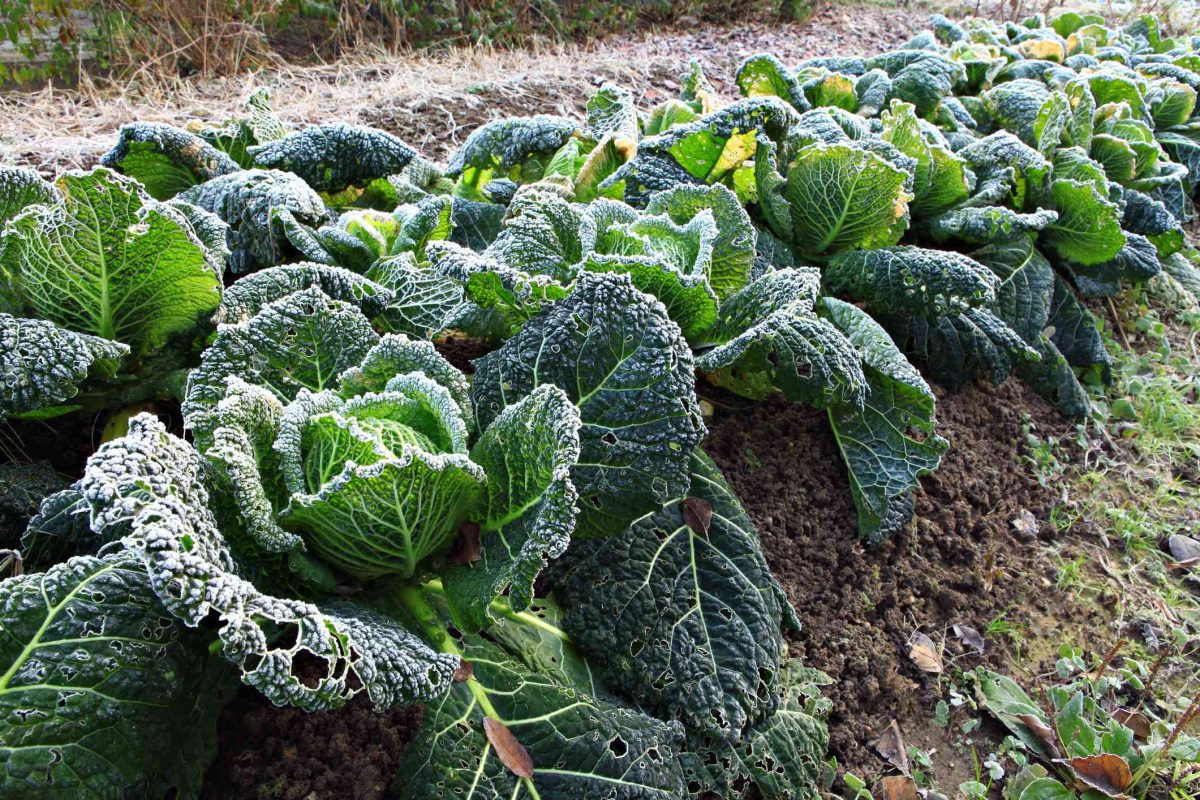
BRASSICA (CABBAGE) FAMILYAll cabbage family members with the same botanical name will cross with each other so I am including botanical names to help seed savers. Radishes and turnips are also in this family but are found under root vegetables. Summer turnips do not cross with winter turnips or rutabagas. BRUSSELS SPROUTS (B. oleracea) – LONG ISLAND IMPROVED (C) (1890's) is relatively early and quite productive. The compact plants (about 20" tall) have stems tightly packed with round firm, dark green sprouts. Brussels sprouts require a long growing season so they are started as bedding plants. CABBAGE (B. oleracea) – EARLY JERSEY WAKEFIELD (C) dates back to the early 1700's in New Jersey and is still readily available today. It is a summer cabbage, tender and flavourful, in the 2-4 lb range, with a distinctive conical head. KALE – A non heading cabbage family member that is grown as a fall and winter crop
as it is very cold and frost tolerant. Leaves are sweeter and more tender after frost. KOHLRABI (B. oleracea) – EARLY WHITE VIENNA (C) (pre-1860) is a light green variety whose enlarged stem or "bulb" is a slightly flattened globe which remains crisp and stringless up to about 2" in diameter. BROCCOLI (B. oleracea) – CALABRESE was brought to the USA by Italian immigrants in the 1880's. It produces tight green heads up to 8" in diameter, and will form side shoots once the main head is harvested. PURPLE PEACOCK was developed by Fank Morton by crossing some broccoli and kales. Green loose heads of broccoli, sweet purple stems and red-veined leaves and it is all edible &ndash raw when young and lightly steamed when mature. INDIAN MUSTARD (B. juncea) &ndash WILD GARDEN PUNGENT MIX is made up of cultivars and experimental crosses of Indian mustard. Leaf colours are golden, green, striped red and solid purple. Leaves may be smooth to savoyed, toothed to plain. Flavours from sweet to hot but tending toward pungent. A perfect salad mix. Petioles and bolting stems are used for stir fries. JAPONICA MUSTARD (B. rapa) &ndash WILD GARDEN MILD MUSTARDS has similar diversity to the Indian mustard mix but is generally milder flavoured. Young plants and buds for salads, all plant parts for stir fries. May contain some oriental turnips with both edible roots and leaves. ROQUETTE or ARUGULA (Eruca sativa) – A strong unusual tasting salad green, which is also used in Indian cooking. GARDEN CRESS (Lepidium sativum) – A fast growing annual providing sharp flavoured greens for salads.
COMPOSITE FAMILYLETTUCE (Lactuca sativa) is native to the Mediterranean Basin and has been cultivated at least since Roman times LEAF: BLACK SEEDED SIMPSON (1850) (C) is an early leaf lettuce with large lightgreen curly leaves. PRIZEHEAD has large loose heads of tender green leaves edged in red. HYPER RED RUMPLE WAVED is a leaf lettuce from Frank Morton of Oregon (see Lettuce Mix). The leaves are very curly and dark red. BUTTERHEAD: MESCHER is an older German butterhead (1700's) that came to North America in the 19th century. It is early and produces small crisp heads whose leaves are edged in red. PIRAT is a tender mid-season butterhead with medium-sized heads edged with red. BUTTERCRUNCH (C) (AAS 1963) makes a tight crisp green head and is slow to bolt. DEER TONGUE: RED DEER TONGUE is a cross of green deer tongue with a very red leaf lettuce. Leaves are long and pointed, red with a white midrib. Makes a head something like a butterhead. ROMAINE: PLATO is a very dark green romaine with dense heads and good disease resistance. DEVIL'S TONGUE has very dark red leaves and fairly loose heads. Not a distinct cultivar (note the two colours of seeds) but a collection of very similar but genetically diverse lines. CRISPHEAD: REINE DES GLACES (ICE QUEEN) has toothed green wrapper leaves and a crunchy white heart. Thinnings are good as leaf lettuce. Of French origin, about 200 years old. MIX: LETTUCE BLEND is a mix of leaf lettuces, butterheads and romaine, mostly greens with a bit of red thrown in. MORTON'S LETTUCE MIX comes from Frank Morton's lettuce breeding program in Oregon which emphasizes organic growing and breeding for taste and disease resistance. Contains about eight new lettuce lines and will give you a wide variety of colours and forms. PHILOSOPHER'S MIX is a mix of about all the colours and forms you can find in romaine (cos) lettuce. From Frank Morton.
CHENOPODIUM (GOOSEFOOT) FAMILYSPINACH (Spinacia oleracea) &ndash Spinach has been grown in Europe at least since the Middle Ages. It self seeds easily and the volunteer plants are often our earliest spring greens. BLOOMSDALE was introduced by the Landreth Seed Co. of Baltimore in 1826 and improved in 1925. LORELEI comes from Europe. It claims to have been grown in the garden of Charlemagne. Plants are smaller and lower yielding than Bloomsdale, with flat fairly thick leaves.
STRAWBERRY SPINACH (Chenopodium capitatum) – Has been around for a long time in Europe and is still available commercially in England. Use the leaves raw or cooked like spinach. Small red berries are produced in the axils of the leaves. The fruits are edible but bland and are an attractive garnish in salads. ORACH (Atriplex hortensis) – Leaves and young shoots are used like spinach. Early and self-seeding. I am offering a pure GREEN selection and one with RED/PURPLE highlights. SWISS CHARD (Beta vulgaris) – Usually cooked, with the leaves and the large midribs cooked separately. Young leaves can also be used in salads. FORDHOOK GIANT (1750) (C) has broad, dark green, heavily crumpled leaves and thick white midribs. RHUBARB CHARD (1857) (C) has deep crimson stalks and leaf veins and dark green, heavily crumpled leaves. FIVE COLOUR SILVERBEET (C) has been available since 1970, sometimes under the name Rainbow Chard. Spectacular range of colours.
UMBELLIFERA FAMILYThis family all have flowers in flat-topped heads (umbels). Dill is probably themost recognizable example but many, like carrots, are biennial so we do not often see their flowers. PARSLEY (Petroselinum crispum) – MOSS CURLED is the most decorative and popular variety and is often used as a garnish. PLAIN or ITALIAN PARSLEY has large flat leaves, is strong flavoured, and is the best variety for drying. DILL (Anethum graveolens) &ndash Leaves, fresh or dried, are excellent in salads, dressings and dips. CORIANDER or CILANTRO (Coriandrum sativum) &ndash Fresh leaves are used in salads and in Asian cooking. Seed is used in mixed pickling spice and it is one of the ingredients in curry powder. CHERVIL (Anthriscus cerefolium) has finely divided parsley-like leaves with a mild anise flavour. Used similarly to parsley. Goes to seed rapidly and may produce two crops in one year. ALEXANDERS or BLACK LOVAGE (Smyrnium Olusatrum) is a biennial or perennial to 5' with yellow flowers in 4" umbels. This Medierranean native has been cultivated as a food crop since at least 322 B.C. and was in Charlemagnes's garden. The young shoots and stalks were blanched and eaten. The unopened flower clusters can be eaten and the root can be grated into salads. Tastes like celery but stronger and was pretty well replaced by celery in the 1800's. Seed germinates in 3-6 weeks if the black husk is rubbed off the seed. Cold stratification also improves germination. CELERY (Apium graveolens) GIANT RED has large red stalks with yellow-pink hearts. More flavour than the commercial pale product. LOVAGE (Levisticum officinale) is a perennial celery. The flavour is strong and the stalks are tough, but it is great for flavouring soups and stews.
MINT FAMILYThis family has many highly aromatic members, both annual and perennial. Annuals used in cooking: BASIL (Ocimum basilicum) – Used to make pesto, and for all Italian dishes. SUMMER SAVORY (Satureja hortensis) &ndash Leaves are used in all bean dishes. Perennials used in cooking (not always winter hardy in Saskatchewan): GREEK OREGANO (Origanum vulgare) has a strong aromatic flavour and is used in all pasta and tomato dishes. SAGE (Salvia officinalis) has large rough-textured grey-green leaves. Used as a seasoning for meat, fowl, sausages, and especially turkey stuffing. THYME (Thymus vulgaris) has tiny purplish flowers on an almost woody plant to about one foot. Used in stuffings and sauces, and with fish, meat, and sausages.
BORAGE FAMILYBORAGE (Borago officinalis) is a coarse, hairy plant growing 2'-3' tall. It is a very good bee plant. The mildly cucumber-flavoured leaves can be used in salads, and the bright blue flowers can be floated on cold drinks.
|
|||||||||||||||